
Bookkeeper vs Accountant: What Is the Difference in Canada?

Short answer: A bookkeeper records and reconciles your business transactions every month and handles routine filings such as GST/HST and payroll. An accountant uses those finished books to prepare year-end financial statements and tax returns, and to give tax advice. Most small businesses in Canada use both. At Remote Bookkeeping, the bookkeeping side has published prices.
Bookkeeping is the day-to-day recording of what your business earns and spends. Accounting is the work of reading those records, preparing statements that others rely on, and planning taxes. The bookkeeper vs accountant question is less about choosing one and more about knowing who does what.
What does a bookkeeper do for a small business?
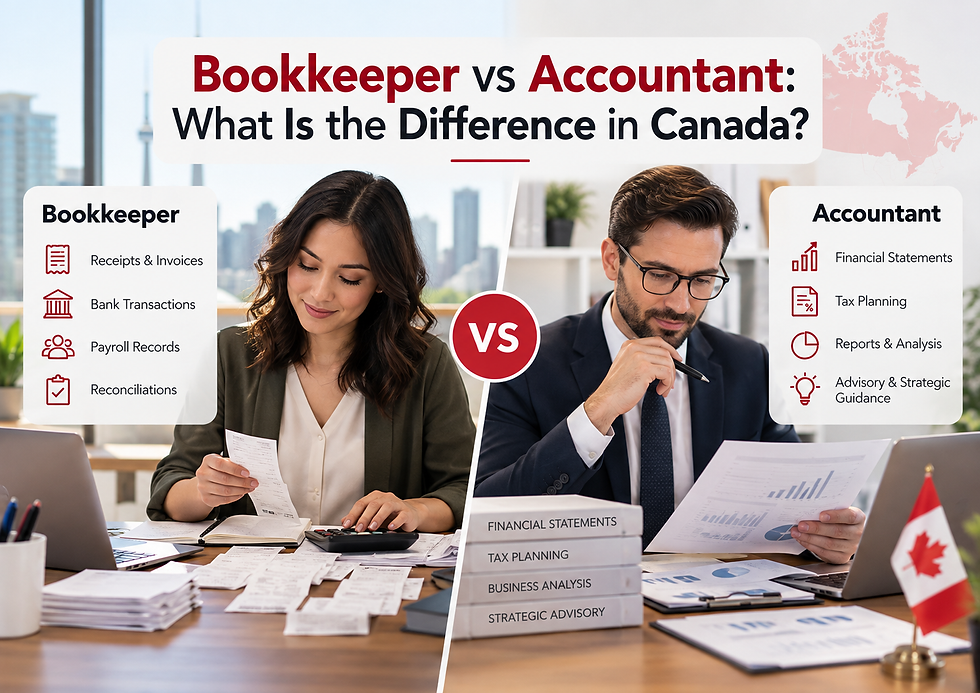
A bookkeeper keeps your books current and accurate, month after month. A typical monthly routine covers:
Recording. Sales, bills, receipts and bank transactions are entered and given the right account in QuickBooks Online or Xero.
Reconciling. Every bank and credit card account is matched to its statement, so the balances agree.
Monthly reports. A Profit and Loss statement and a Balance Sheet, so you can see how the business is doing.
Payroll. Pay runs, source deductions, T4 slips at year-end and Records of Employment.
Routine filings. GST/HST returns and workers' compensation reports, such as WSIB in Ontario.
These are the services you can choose in our monthly plans. Our post on what monthly bookkeeping includes walks through each one.
What does an accountant do that a bookkeeper doesn't?
An accountant works from your finished books to prepare the year-end work and advise you on tax. Many small businesses work with a CPA (Chartered Professional Accountant) firm for this.
Year-end financial statements. The statements your bank, investors and the CRA see.
Corporate tax return (T2). The CRA says all resident corporations, with a few exceptions, have to file a T2 return for every tax year, even if there is no tax payable.
Personal tax returns for the owners.
Tax planning. For example, whether to pay yourself a salary or dividends.
Review or audit engagements when a lender or investor asks for more than a compilation.
Can a bookkeeper do my taxes?
Partly. A bookkeeper can prepare and file your routine business filings. Income tax returns and tax planning belong with your accountant.
Filing or task | Usually done by |
GST/HST returns | Bookkeeper |
Payroll remittances and T4 slips | Bookkeeper |
T5 slips for dividends | Bookkeeper, once the accountant has set the dividend |
WSIB reports (Ontario) | Bookkeeper |
Corporate tax return (T2) | Accountant |
Owners' personal tax returns | Accountant |
Tax planning and advice | Accountant |
Some firms do both jobs. Remote Bookkeeping does the bookkeeping side only: your accountant prepares the year-end financial statements and tax returns.
For the CRA to deal with your bookkeeper or accountant, you authorize them as a representative. The fastest way is in My Business Account. Form AUT-01 by mail also works, but it gives access by phone, mail, fax and in person only, not online.
Can a bookkeeper prepare financial statements?
Yes for monthly reports you use yourself. Year-end statements that a bank or other outsider will rely on are the accountant's work.
The monthly Profit and Loss and Balance Sheet from your bookkeeper are management reports. They show you where the business stands, and our post on which financial reports to read explains them.
Year-end statements for a lender, landlord or investor are different. In Ontario, CPA Ontario says a public accounting licence is needed to sign a review or audit report. It is also needed for a compilation engagement when a third party can be expected to rely on it, or when the prescribed Compilation Engagement Report wording is used. Other provinces have their own rules.
Do I need a bookkeeper, an accountant, or both?
Most incorporated businesses use both. A small sole proprietor may keep their own records and only see an accountant at tax time.
Your business | Bookkeeper | Accountant |
Sole proprietor, few transactions, not registered for GST/HST | Optional, if you keep good records yourself | Helpful at tax time |
Registered for GST/HST | Usually, for regular GST/HST returns | At year-end |
Corporation | Usually, every month | Every year, for the T2 and year-end statements |
Employees on payroll | Usually, for pay runs, remittances and T4s | At year-end |
Books months or years behind | Catch-up first | Once the books are current |
If your books have fallen behind, start with catch-up bookkeeping. The accountant needs reconciled books before the year-end work can start.
Is a bookkeeper cheaper than an accountant?
They are priced for different jobs, so compare the work, not the hourly rate. Bookkeeping is routine work every month. Most accounting fees come once a year, at year-end.
Clean, reconciled books also save time at year-end, because your accountant spends less of it fixing entries. At Remote Bookkeeping, our prices are published. You build your plan from only the services you need and pay only for those, at the same price across Canada. Our post on bookkeeping cost in Canada shows how the plans work.
How do a bookkeeper and an accountant work together at year-end?
The bookkeeper hands over clean, reconciled books. The accountant turns them into year-end statements and tax returns.
Close the year. The bookkeeper reconciles every account to the year-end statements.
Send the package. Reports, reconciliations, payroll and GST/HST summaries go to the accountant. Our year-end checklist lists what they need.
Questions. The accountant reviews the books and asks about anything unusual.
Adjustments. The accountant's year-end adjusting entries are recorded in the books, so the books match the final statements.
Statements and returns. The accountant prepares the year-end financial statements and the T2.
We work alongside accountants every day. We can deal with your accountant directly, and accounting firms can use us as their back-office bookkeeping team, client-facing or behind the scenes.
Frequently asked questions
Do I still need an accountant if I use QuickBooks Online?
For most corporations, yes. QuickBooks Online holds the records, but someone still has to enter and reconcile them, and an accountant still prepares the year-end statements and the T2.
Who decides whether I pay myself a salary or dividends?
Your accountant, based on your tax situation. Your bookkeeper then runs the payroll or prepares the T5 slip.
Can my bookkeeper talk to the CRA for me?
Yes, once you authorize them as your representative with the CRA. The CRA can then deal with them on the accounts you authorized, online or by phone and mail, depending on how you set it up.
Can a bookkeeper fix books that are years behind?
Yes. That is catch-up bookkeeping: every missing month is recorded and reconciled, oldest first. Contact us for an assessment and estimate.
Sources
Find out if you have to file a corporation income tax return (T2) - Canada Revenue Agency
Authorize a representative: How to give authorization - Canada Revenue Agency
When is a Public Accounting Licence required in Ontario? - CPA Ontario
Services, Pricing and For accounting firms - Remote Bookkeeping
About Remote Bookkeeping
Remote Bookkeeping is a Canadian-owned firm providing monthly bookkeeping, financial reporting, payroll, HST/GST filing, year-end preparation and QuickBooks Online setup for small businesses across Canada. Founded by Lia and George, with more than 30 years of combined experience. Call (289) 867-0808 or 1-800-880-9141, or contact us. Related reading: Year-End Checklist: What Does Your Accountant Need?
This article is general information for Canadian small business owners. It is not tax, legal or accounting advice for your particular situation. Rates and thresholds change - always confirm against the source linked above or ask us.


Comments